“How much does a website cost?” is the question every agency dodges, and the dodge is understandable — the honest answer is “it depends”. But it depends on a knowable list of things, and this article names them. By the end you should be able to estimate your own WordPress website cost within a band, read a quote properly, and tell an expensive build from an overpriced one.
The short answer: what a WordPress website cost looks like
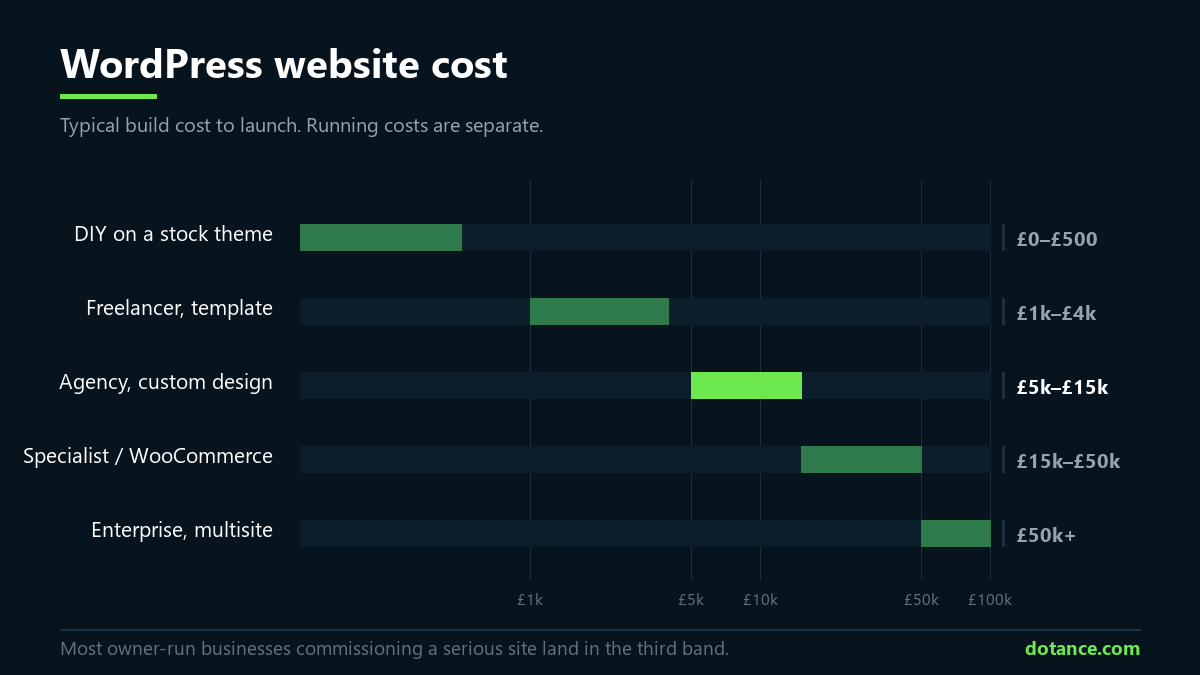
Here are the real bands. These are build costs — design and development to launch, excluding ongoing fees.
| Approach | Typical build | Sensible when |
|---|---|---|
| DIY on a stock theme | $0–$700 | Validating an idea, or a site nobody needs to find |
| Freelancer, template-based | $1,400–$5,400 | Small brochure site, standard content, no integrations |
| Small agency, custom design | $6,800–$20,000 | The site is a real sales channel |
| Specialist build or WooCommerce | $20,000–$67,500 | Integrations, complex catalogue, multiple languages |
| Enterprise / multisite | $67,500+ | Many sites, many teams, compliance obligations |
Most owner-run businesses commissioning a serious site land in the third row. If your budget is $2,700 and you are being quoted $19,000, neither party is wrong — you are describing different projects, and the next sections explain which.
WordPress website cost by type of site
The bands above are about who builds it. This table is about what you are building, which is usually the more useful question when you are setting a budget.
| Type of site | Typical build | What moves the number |
|---|---|---|
| One-page or launch site | $1,000–$3,400 | Little. This is a template and your copy. |
| Small business brochure, 6–10 pages | $4,000–$9,500 | Whether the design is yours or a theme’s |
| Service business with real content | $9,500–$20,000 | Template count, copywriting, lead flows |
| Multi-location or multi-language | $16,000–$40,500 | Translation workflow, per-location content model |
| WooCommerce store | $13,500–$54,000 | Catalogue size, tax and shipping rules, integrations |
| Membership or booking platform | $20,000–$81,000 | Business logic, payments, user roles, edge cases |
Two things surprise people in this table. A brochure site and a store are not in the same conversation — the WordPress website cost for a shop is typically double a comparable non-shop build, because tax, shipping, payment and order flows all have to be right rather than merely present. And multi-language is not a plugin; it is a permanent content operation you are agreeing to run.
What actually drives the price
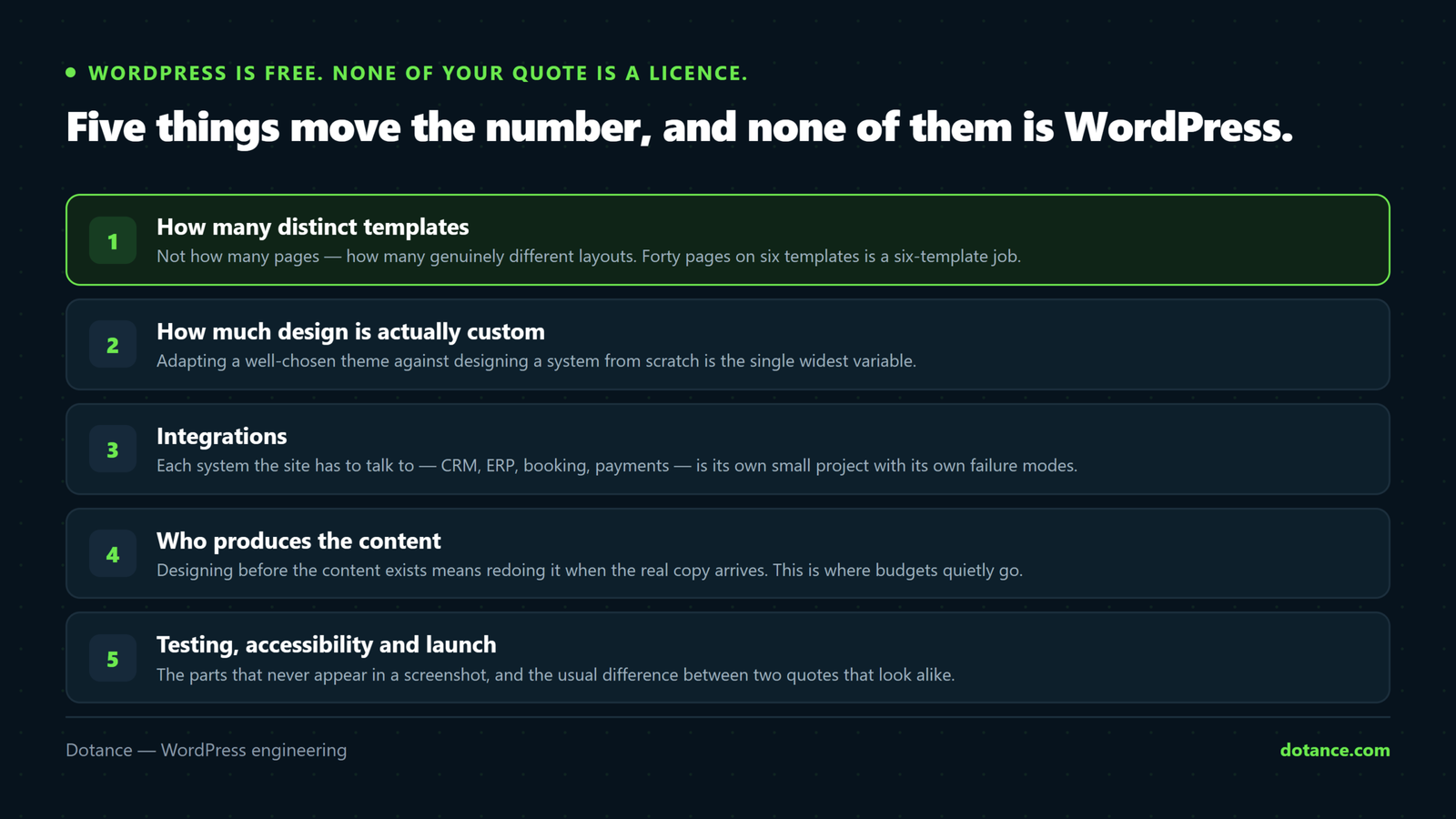
WordPress is free. Nothing about your quote is a WordPress licence. The WordPress website cost you are quoted is almost entirely people’s time, and these are the five things that consume it.
1. How many genuinely different pages exist
Not page count — template count. Forty service pages built from one template is a smaller job than eight pages that each look different. When you brief a project, count the layouts, not the URLs.
2. Custom design versus a theme
A stock theme with your logo is a few hundred pounds of setup. A design made for your business — your content, your customers, your conversion path — is typically $4,000–$11,000 of the total on its own. Both are legitimate purchases. Only one of them will look like nobody else.
3. Integrations
This is the line that moves budgets most, and the one clients mention last. A CRM, a booking system, an ERP, a payment gateway with unusual rules, a stock feed — each is a small project with its own testing and its own failure modes.
4. Content
Copywriting, photography, product data entry, migrating 300 old posts. Content is usually 20–30% of a project and it is the most common reason projects run late, because it is the part the client owns.
5. Who edits it afterwards
A site a marketing team publishes to weekly needs guardrails — locked layouts, reusable patterns, documentation. That work adds to the WordPress website cost at build time and removes a great deal of cost later. A site nobody touches does not need it.
The single cheapest way to lower a quote is to reduce template count. Not features, not quality — layouts. Three well-made templates used across twenty pages costs a fraction of twenty bespoke pages and, done properly, nobody can tell.
Where the money goes inside a build
A typical $13,500 mid-range WordPress website cost splits roughly like this. The proportions matter more than the numbers — if a quote is a very different shape, ask why.
| Phase | Share | What it buys |
|---|---|---|
| Discovery and content model | 10% | Deciding what the site holds before anyone designs it |
| Design | 30% | Layouts, states, mobile, a system rather than pictures |
| Build | 35% | Templates, components, integrations, the CMS itself |
| Content migration and entry | 10% | Getting the real words and images in |
| Testing and launch | 10% | Devices, forms, redirects, accessibility, going live |
| Training and handover | 5% | Your team being able to run it |
Two observations from years of quoting. Discovery looks like the easiest line to cut and is the most expensive one to skip — the decisions get made anyway, just later and by the wrong person. And testing is where cheap quotes hide: it is invisible on a proposal and extremely visible on launch day.
A worked example: what $12,750 actually buys
Percentages are easy to nod at. Here is the same mid-range WordPress website cost as an itemised quote for a fictional but entirely typical service business — eight templates, thirty pages, one CRM integration.
| Line | Cost | Notes |
|---|---|---|
| Discovery workshop and content model | $1,300 | Two sessions, a documented sitemap and page purposes |
| Design — 8 templates, mobile and desktop | $3,800 | Includes states, empty states and a component sheet |
| Build — templates and components | $3,500 | Block patterns, locked layouts, editor guardrails |
| CRM integration and lead routing | $1,000 | Form to CRM, tested with real submissions |
| Content migration, 30 pages | $1,300 | Client supplies copy; we lay it out and check it |
| Testing, accessibility and launch | $1,300 | Devices, forms, redirect map, Search Console |
| Training and documentation | $550 | Recorded session plus a written runbook |
| Total | $12,750 | Excludes hosting, licences and maintenance |
Notice what a quote like this makes possible: you can remove the CRM integration and know exactly what you save. A single-line quote gives you no such lever, which is precisely why single-line quotes are convenient for the supplier.
How agencies actually price the work
Three models are common, and knowing which one you are being sold explains a lot about the WordPress website cost in front of you.
| Model | Good for | Watch for |
|---|---|---|
| Fixed price | Well-defined scope; you carry no overrun risk | Scope is defined tightly, so changes are billable |
| Day rate | Exploratory or evolving work | No ceiling. Ask for an estimate and a review point. |
| Retained team | Continuous improvement after launch | Needs someone on your side directing it |
Fixed price is right for most first builds, precisely because it forces both sides to agree what the project is before anyone starts. Payment is usually staged — commonly a third to start, a third at design sign-off, a third before launch. Be wary of anything asking for the full amount upfront, and equally of a supplier willing to start with nothing; both are signs of a business that will not be there in year two.
Running costs nobody puts in the quote
The build is the WordPress website cost people compare. The running cost is the number that decides whether the site still works in three years.
| Item | Per year | Optional? |
|---|---|---|
| Domain | $15–$55 | No |
| Hosting | $80–$800 | No — and the cheapest tier is a false economy for a shop |
| Premium plugin and theme licences | $150–$1,000 | Mostly no; they stop getting security fixes when they lapse |
| SSL certificate | $0 | Free via Let’s Encrypt. Be suspicious of anyone charging. |
| Transactional email service | $0–$150 | Needed if your forms and receipts must actually arrive |
| Offsite backups | $0–$150 | No |
| Maintenance plan | $800–$4,000 | Technically yes. Practically, see below. |
The maintenance line is where people economise and later regret it. WordPress core, plugins and PHP all move; an unattended site does not stay still, it decays. What a plan should and should not include is covered in what a maintenance plan should actually include — including the one question that tells you instantly whether a provider is serious.
You can absolutely do this yourself. The failure mode is not incompetence, it is postponement.
The five-year WordPress website cost is the one that matters
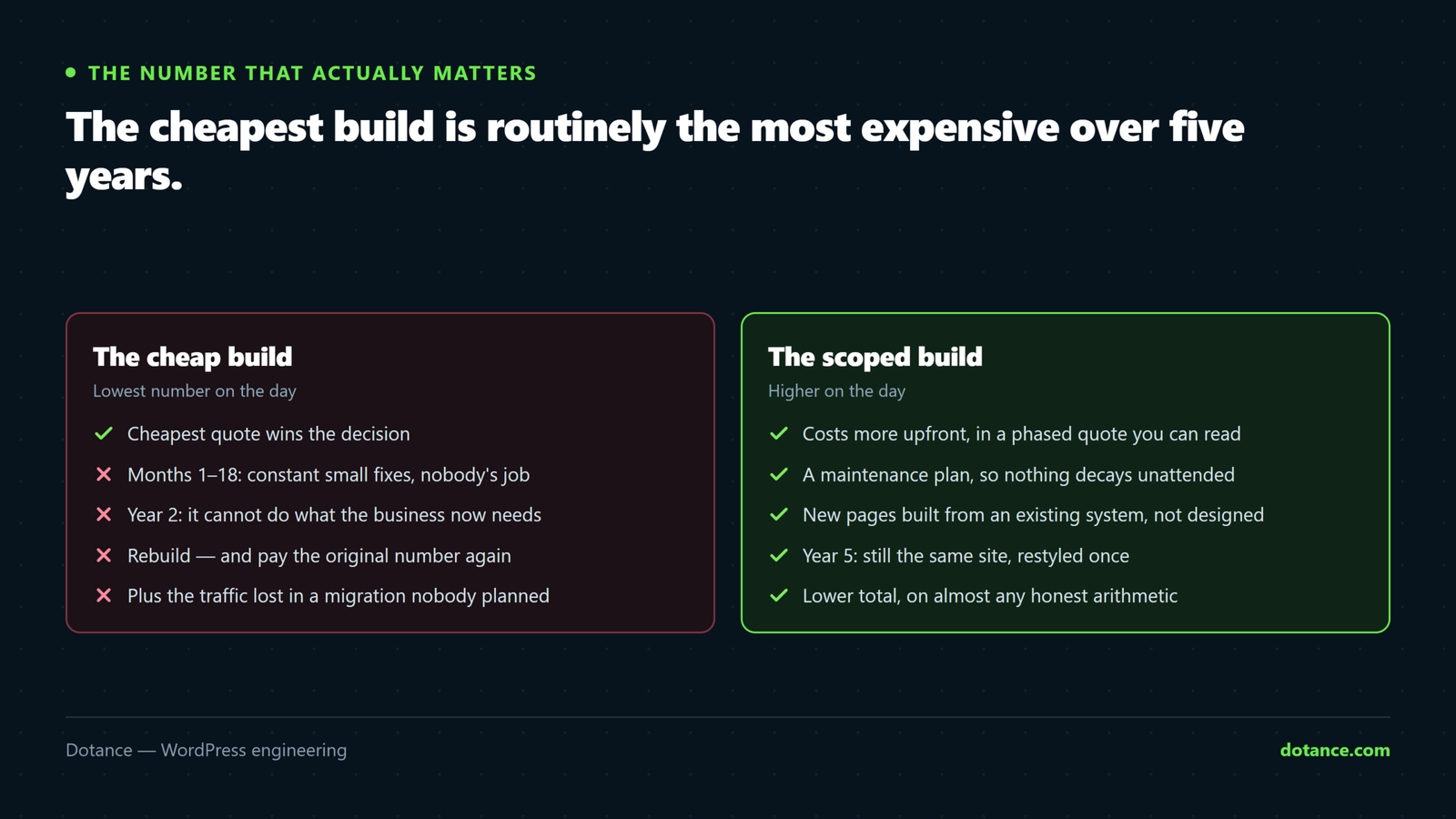
Comparing build quotes alone is how businesses buy the wrong site. Compare total cost of ownership instead. Here are two realistic paths for the same business:
| Cheap build | Considered build | |
|---|---|---|
| Initial build | $2,700 | $13,500 |
| Running costs, 5 years | $2,000 | $8,100 |
| Fixes and rescue work | $4,000 | $0 |
| Rebuild in year 3 | $11,000 | $0 |
| Five-year total | $19,700 | $21,600 |
The cheap path is not always wrong. It is wrong when the site matters, because you spend nearly the same money and spend three of the five years with a website that undersells you. That is the real WordPress website cost calculation, and it is rarely the one on the table.
What you pay for that you cannot see
When two WordPress website cost quotes differ by $8,100, the difference is usually in things that never appear on a screenshot:
- Accessibility. Contrast, focus states, keyboard order, real form labels. Cheap to build in, expensive to retrofit, and increasingly a legal question rather than a nicety.
- Performance budget. Deciding what a page is allowed to weigh, and holding to it. See improving LCP for what that discipline protects.
- Empty and error states. What the page does when the image is missing, the list is empty or the form fails.
- Editor guardrails. Whether your team can break the design — the reasoning is in design systems and block patterns.
- A real testing matrix. Devices, browsers, and a genuine test submission of every form.
- Documentation and handover. Whether the next developer can work on it without starting over.
None of these are visible in a design review. All of them are visible in year two.
Where budgets actually get wasted
Whoever builds it, the same money-burners inflate the WordPress website cost:
- Designing before the content exists. Everything gets redone when the real copy arrives. See how to brief a design project for what to prepare instead.
- Bespoke features nobody uses. The clever filter that took two weeks and gets clicked four times a month.
- A mega-theme with 200 demos. You pay for its weight on every page load, forever — the reasoning is in choosing a theme that will not slow you down.
- Building what a maintained plugin already does. The buy-or-build decision has a right answer more often than people think.
- Redesigning without protecting rankings. A new site that loses the traffic the old one earned is not a saving. Redesigning without losing SEO covers the preventable part.
- Committee sign-off. Every extra approver adds revision rounds, and revision rounds are billable.
How to get quotes you can actually compare
Three WordPress website cost quotes for “a website” will come back at $2,700, $12,000 and $32,500, and you will learn nothing from the spread. Fix the variables first and the numbers become comparable.
Give every agency the same brief containing:
- Template count, not page count — “about 8 distinct layouts across roughly 30 pages”.
- Content model — services, locations, case studies, products, and rough quantities.
- Integrations, named. “CRM” is not a requirement; “HubSpot, two-way” is.
- Who writes the copy and who supplies photography.
- Who edits the site after launch, and how often.
- Migration scope — how many existing URLs, and whether rankings are in play.
- Your budget range. Withholding it does not get you a better price; it gets you a proposal for a different project.
Then ask each supplier to break their WordPress website cost into the phases in the table above. Anyone who cannot split their own number has not planned the work.
Red flags in a quote
| Sign | What it usually means |
|---|---|
| One line, one number, no phases | The work has not been thought through |
| No mention of testing or launch | It is coming later as a change request |
| “Unlimited revisions” | Either caveated in the small print, or unsustainable |
| Hosting locked to their account | Leaving later becomes a migration project |
| No handover or training line | You will be paying them for text changes in year two |
| Guaranteed first-page rankings | Nobody can guarantee that. Walk away. |
| Far cheaper than everyone else | Something is out of scope. Find out what before signing. |
None of these are automatically disqualifying — but each should be a question you ask out loud before signing, not a discovery you make in month three.
Is WordPress even the cheapest option?
Usually, over any reasonable horizon, the WordPress website cost is the lowest available — but for reasons people get wrong. WordPress being free open-source software is the least important part. What matters is that it carries no per-seat licence, no platform transaction fee, thousands of people who can work on it, and no vendor who can change your terms.
Hosted builders can be cheaper to start and more expensive to stay — monthly fees, transaction cuts, and a ceiling you hit exactly when the business starts working. The switching cost from a closed platform is real, and it always arrives at the least convenient moment.
The honest exception: if you need five pages and will never touch them again, a hosted builder may genuinely be the right call. Commissioning a bespoke build for that is money spent to feel professional.
Common questions about WordPress website cost
How much does a WordPress website cost for a small business?
Most small businesses commissioning a custom site pay between $6,800 and $20,000 to build, plus $800–$2,700 a year to run. Below roughly $4,000 you are buying a template configured for you, which is a legitimate purchase as long as you know that is what it is.
Why do quotes vary so much for the same brief?
Because the brief is rarely the same in each supplier’s head. One is quoting a theme with your content in it; another is quoting a design system, integrations and testing. Fix the variables in the section above and the spread narrows dramatically.
Can I reduce the WordPress website cost without ruining the site?
Yes, in this order: cut template count, supply your own content on time, use maintained plugins instead of custom code, and launch in phases. Cutting testing, discovery or training saves money on the invoice and costs more within the year.
Is a WordPress website cost a one-off payment?
No, and treating it as one is the most expensive assumption in this article. Budget for hosting, licences and maintenance from day one — roughly 10–20% of the build cost per year is a realistic planning figure.
How long does a WordPress site take to build?
A template-based small site, two to four weeks. A custom mid-range build, six to twelve weeks, most of which is decisions and content rather than development hours. Timelines slip on content far more often than on code.
Do I need to pay for WordPress itself?
No. The software is free. You pay for hosting, for any premium plugins or themes you choose, and for the people who design, build and look after the site.
Does a cheap website cost more in the end?
Often, yes — as the five-year table above shows. The trap is not the low price; it is buying a low price for a job that needed a considered build, then paying for the rescue and the rebuild as well.