Most design briefs are either a list of sites the client likes, or a fifty-page requirements document nobody reads. Neither produces good work. Here is what actually helps.
Start with your content, not your inspiration
The most useful thing you can bring is an honest picture of what the site has to hold. Not the copy — just the shape of it.
- What types of thing exist? Services, products, locations, case studies, events, people?
- Roughly how many of each, now and in two years?
- What does each need to show?
- Which of them relate to each other?
This is the content model, and it should drive the design. A site designed before anyone asked what it holds ends up forcing everything into the wrong shape, and the workarounds become the architecture.
If you already have a site, you do not have to guess — count it:
# What exists, and how much of it
wp post list --post_type=page --post_status=publish --format=count
wp post list --post_type=post --post_status=publish --format=count

# Every content type on the site, including ones you forgot about
wp post-type list --fields=name,label,public

# The pages worth arguing over: longest first
wp post list --post_type=page --fields=ID,post_title,post_name --format=csv
Most rebuild conversations improve immediately once someone says “it is 41 pages, not about 20”.
Bring real content, or realistic content
Designs built on three-word headlines and perfect square images look wonderful, then break on launch day when the real product name is nine words long and half the entries have no photo.
If final copy is not ready, provide realistic samples. Specifically:
| Provide | So the design survives |
|---|---|
| Your longest real headline | Two-line titles that push the layout |
| Your longest description | Cards of uneven height |
| An entry with no image | The gap where a photo was assumed |
| An entry with almost no content | The nearly-empty page nobody designed |
| A real name with an accent or apostrophe | Encoding problems, found early |
| Your worst-quality supplied photo | The crop that only works at 2000px wide |
Designing for the worst realistic case costs nothing during design and a great deal afterwards.
Decide who edits the site
This changes what should be designed more than almost anything else.
- A marketing team publishing weekly needs a component library with guardrails so the brand cannot drift — see design systems and block patterns.
- One person updating quarterly needs something simple and hard to break.
- Nobody internal means the design can be more bespoke, because changes will come through an agency anyway.
Say which of these you are. It is one sentence and it shapes the whole engagement.
Be specific about who it is for
“Our customers” is not a brief. Who is actually landing on the site, what do they already know, what are they trying to do, and what makes them leave?
If you have search data, support tickets or sales call notes, share them. The questions customers already ask are the best available guide to what the site should answer — and they are evidence rather than opinion, which makes internal disagreements much shorter.
Define what “done” means
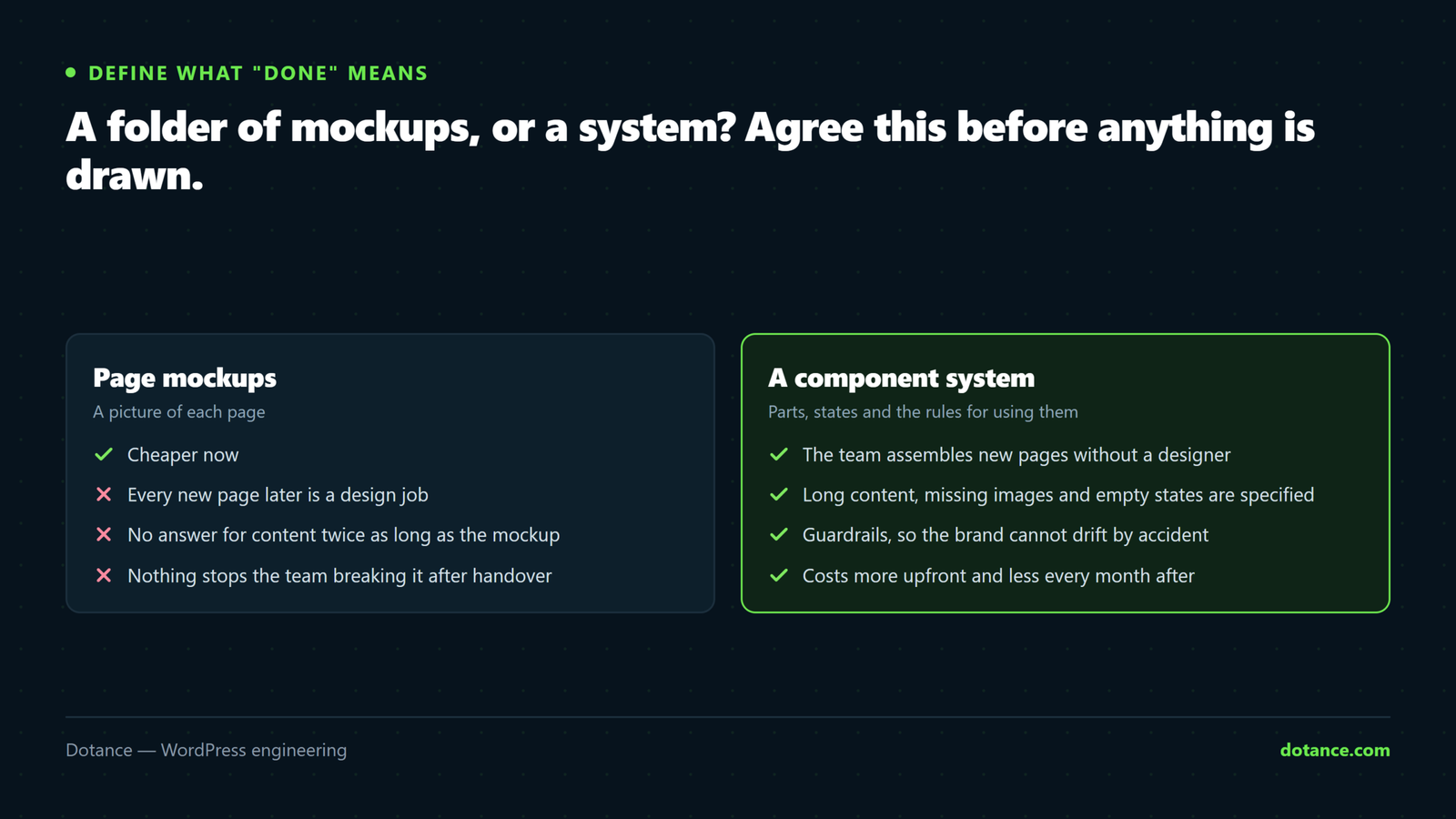
Agree upfront what you are receiving. A folder of page mockups, or a system?
| You get | Which means |
|---|---|
| Page mockups | Cheaper now. Every new page later is a design job. |
| A component system | Tokens, states, patterns, documentation. Your team builds pages without you. |
| Design plus build | One party accountable for whether it actually works |
| Design only, built elsewhere | Cheaper, and someone must own the gap between the two |
A system costs more, and it is the difference between a design that holds together in two years and one that has quietly become fourteen button styles.
Questions worth asking any agency
- How will this behave with content twice as long as the mockup?
- What happens when an image is missing, or a section is empty?
- What stops our team breaking the design after launch?
- What are the hover, focus, loading and error states?
- How is accessibility handled — contrast, focus order, target sizes?
- What exactly do we receive at handover, and who owns it?
- What happens to our existing rankings and URLs?
The answers tell you quickly whether you are buying pictures or a system. A team that has not thought about empty states has not thought about your site being used. And if the answer to the last one is vague, read redesigning without losing rankings before signing anything — that is where redesigns most often go wrong in a way nobody notices for two months.
The commercial terms people forget
Settle these in the brief, not in an awkward email in week six:
| Term | Agree |
|---|---|
| Revisions | How many rounds, and what counts as one |
| Sign-off | Who approves — one named person, not a committee |
| Content deadline | Your side of the schedule, in writing |
| Ownership | Source files, code, repository access on final payment |
| Licensing | Fonts and stock images — in whose name? |
| After launch | Warranty period, then what — see maintenance |
The commonest cause of a late project is not the agency — it is content. Copy, photos and product data arrive weeks after everything else. Put your content deadline in the brief with the same weight as theirs, and name who is responsible for it.
What you can safely skip
- Prescribing layouts. Describe the problem; that is what you are paying for.
- A long list of sites you like. Two or three, with a sentence on why, beats twenty without.
- Exhaustive feature lists written before anyone has looked at your content.
- Choosing the technology first. That follows the content model, not the other way round.
- Colour preferences from one stakeholder. Brand constraints yes, personal taste no.
A brief that fits on two pages
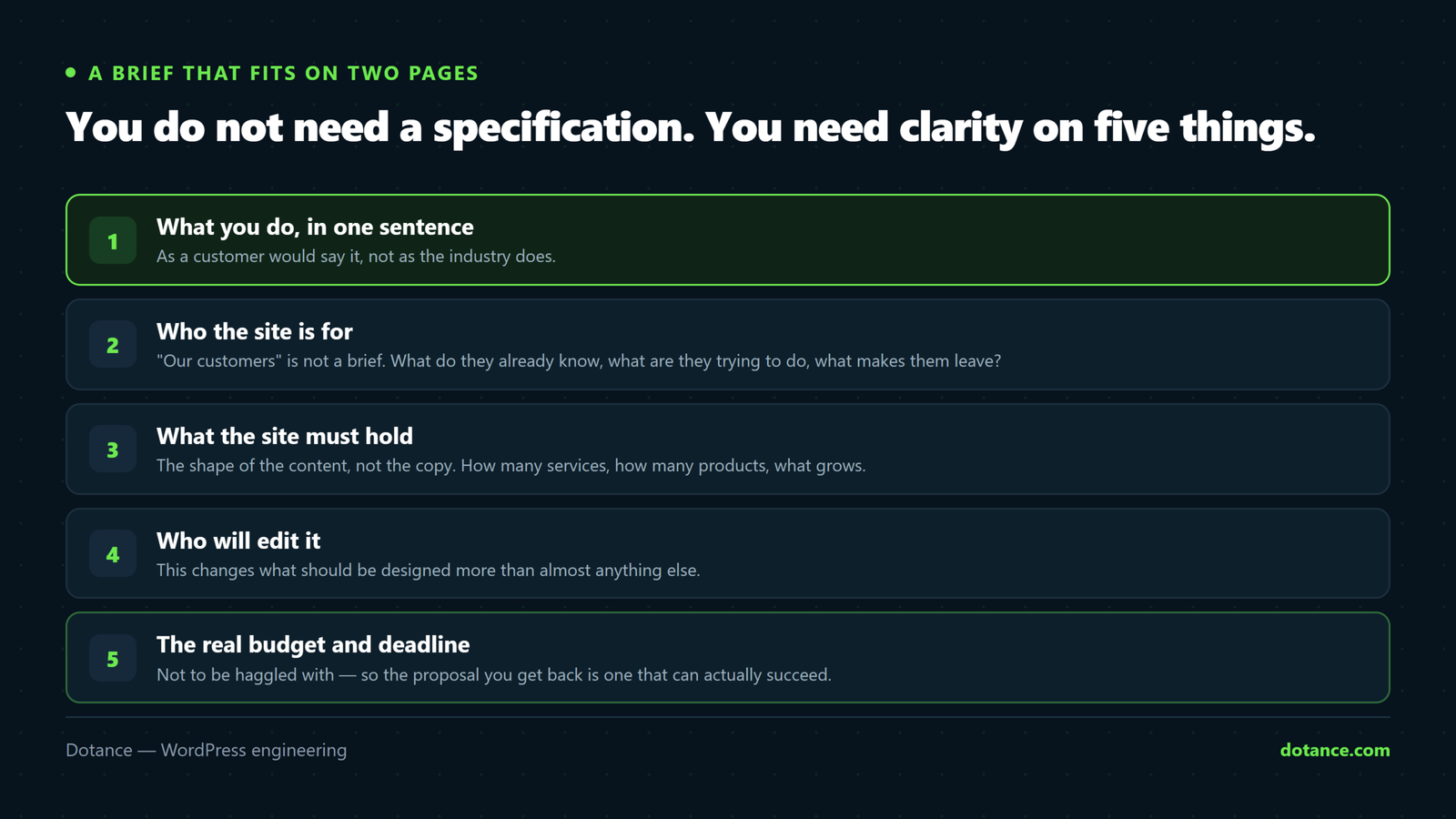
- What we do, in a sentence — as a customer would say it, not as the industry does.
- Who the site is for — and what they are trying to do.
- What the site must hold — the content model, with rough counts.
- What success looks like — enquiries, bookings, fewer support calls. A number if you have one.
- Who edits it, and how often.
- Constraints — brand, integrations, hosting, compliance, deadline.
- Budget range — a range is enough.
- Two or three references, each with a reason.
That is a better brief than most fifty-page documents, and you can write it in an afternoon.
One last thing
Be honest about budget and deadline early. Not to be haggled with — so the proposal you get back is one that can actually succeed. A designer who knows the real constraints will tell you what is possible within them, or tell you it is not. Both answers are more useful than a proposal built on a number nobody believed.
Common questions
We do not know our budget. What do we say?
Give a range, or say what the outcome is worth. “Somewhere between five and fifteen thousand” is genuinely workable; “what would it cost?” with no anchor produces proposals that miss in both directions and waste everyone’s time.
Should we write the copy or should the agency?
Either, as long as it is decided and priced. What does not work is assuming the other party is doing it — which is how sites launch with placeholder text still on the about page.
How long should a site take?
For a considered small business site, usually a couple of months of elapsed time, most of which is decisions and content rather than design hours. Anything much faster is a template fill, which is a legitimate choice if that is what you are knowingly buying.
Can we brief a redesign the same way?
Mostly yes, with one addition: bring your current analytics and your top-performing pages. A redesign that ignores what already works is how businesses redesign their way to less traffic.