Grow · eCommerce

WooCommerce development for stores that outgrew their theme.

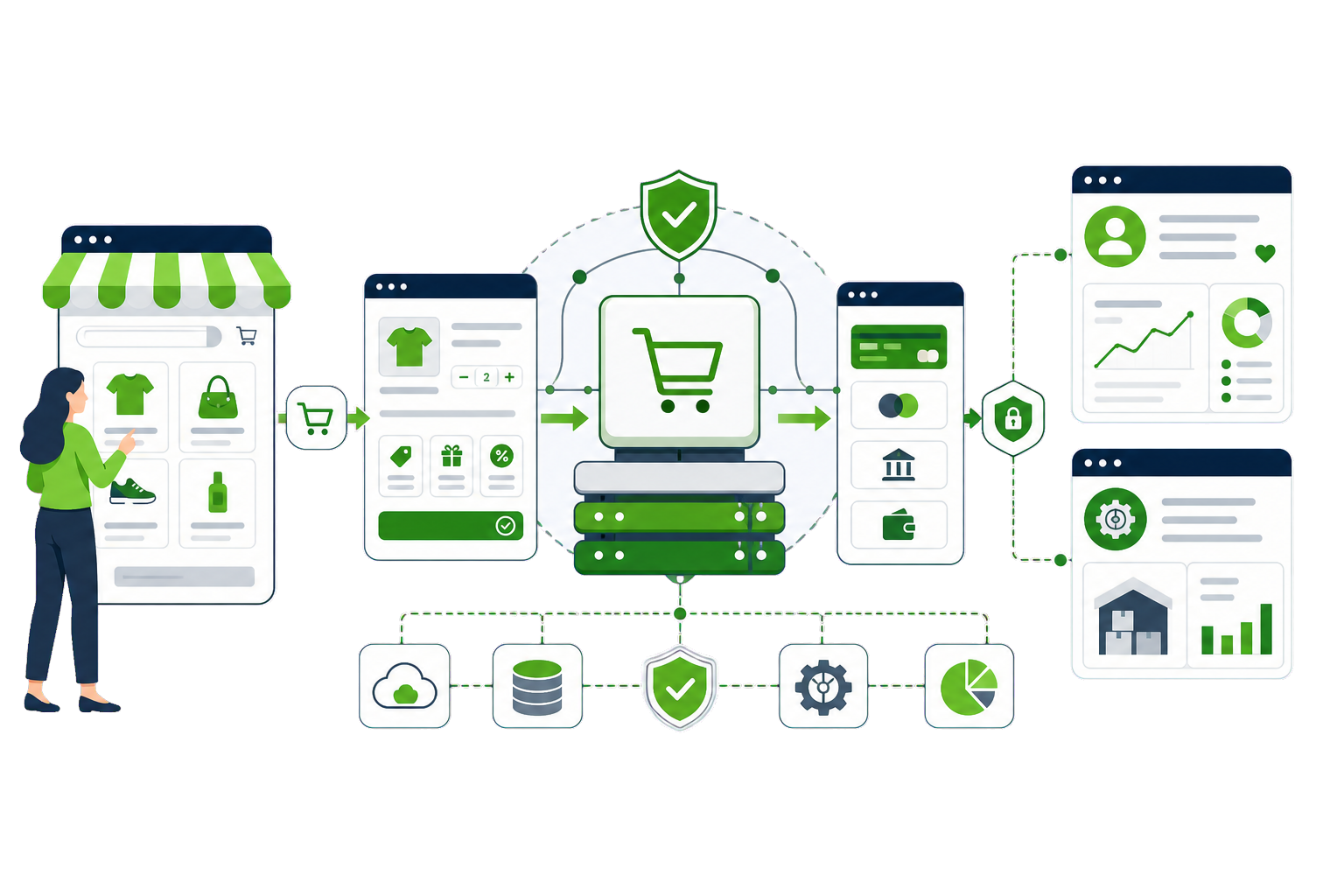
When a store starts making real money, the theme that launched it becomes the thing holding it back. We rebuild the parts that matter — checkout, subscriptions, pricing logic and the integrations behind them — without throwing away what already works.

  • Custom checkout that fits how you actually sell
  • Subscriptions, memberships and B2B pricing
  • ERP, CRM and inventory kept in sync

The problem

What usually brings people here.

Checkout leaks money

Carts fill up and then empty. The default checkout asks for fields you don't need, hides costs until the last step, or breaks on mobile — and every extra step costs a percentage of revenue.

The catalogue outgrew the theme

What was fast with 200 products crawls at 20,000. Filters time out, admin pages hang, and logged-in traffic bypasses every cache you have.

Everything is manual

Orders get copied into the ERP by hand. Stock is wrong by the afternoon. Someone exports a CSV every morning because two systems have never spoken to each other.

Plugin stack is a house of cards

Fifteen extensions do the work of three, half are abandoned, and nobody updates anything because the last update took the store down for an hour.

What we build

The work, specifically.

Discuss your store ↗︎

Custom checkout

One-page or multi-step, the fields you actually need, address validation, and shipping and tax shown before the final click. Built on the Checkout Block or classic checkout depending on what your extensions support.

Subscriptions & memberships

Recurring billing, trials, pauses, upgrades and dunning that recovers failed payments instead of silently losing the customer. Member-only pricing and content where it applies.

B2B & wholesale

Customer-group pricing, tiered quantity breaks, quote requests, purchase orders, tax exemption and account-level credit terms — alongside your retail storefront, not instead of it.

Payments & tax

Stripe, PayPal and regional gateways wired correctly, including SCA, saved cards and refunds. Automated tax where you need it, and clean handling of multi-currency.

ERP, CRM & inventory sync

Two-way integrations so orders, stock, customers and invoices move between WooCommerce and your back office automatically — with retry logic and a log you can actually read when something fails.

Performance at scale

Object caching, query optimisation, index tuning and a strategy for the pages caching cannot help — cart, checkout and My Account. Measured with field data, not lab scores.

How it works

Audit first. Rebuild only what needs it.

  1. Store audit

    Data model, extension stack, checkout funnel and performance under real traffic.

  2. Scope

    A dated plan showing what gets rebuilt, what stays, and what we recommend removing.

  3. Build

    Work happens on staging with your real catalogue, so nothing is a surprise at launch.

  4. Test

    Checkout paths, payment edge cases, tax rules and load — before a customer meets them.

  5. Launch

    Deployed in a low-traffic window with a rollback ready and someone watching orders.

  6. Support

    Monitoring, updates and a channel for the questions that come after go-live.

Results

What the work produced.

Subscription commerce

Recurring billing that stopped losing customers

A subscription box running on stock extensions was silently churning customers whenever a card expired. We rebuilt the billing flow with proper dunning, card-update prompts and a pause option instead of cancel-only.

+62% conversion rate
−38% involuntary churn

B2B commerce

One store serving retail and wholesale

A manufacturer was running two separate sites because their retail store could not handle trade pricing. We merged them into one WooCommerce install with customer groups, quantity breaks and purchase orders.

3.8M+ monthly pageviews
1 store replacing two

Capabilities

The commerce stack we work in.

Core & extensions

  • WooCommerce
  • Checkout Blocks
  • WooCommerce Subscriptions
  • Memberships
  • Bookings
  • Product Add-Ons
  • Custom extensions

Payments & tax

  • Stripe
  • PayPal
  • Klarna
  • Apple & Google Pay
  • SCA / 3DS
  • Multi-currency
  • Automated tax

Integrations

  • REST API
  • Webhooks
  • Action Scheduler
  • ERP sync
  • CRM sync
  • Inventory systems
  • Shipping carriers

Scale & reliability

  • Redis object cache
  • Query optimisation
  • Database indexing
  • HPOS order tables
  • Staging & Git deploys
  • WP-CLI

Engagement

Three ways this usually runs.

Store audit

Fixed fee

A written report on your data model, extension stack, checkout funnel and performance, with a prioritised list of what to fix and what it is worth fixing.

  • 2–3 weeks
  • No obligation to continue
  • Yours to take elsewhere

Ongoing retainer

Monthly

A set number of hours each month for improvements, extension updates, monitoring and the things that come up when a store is genuinely busy.

  • Rolling monthly
  • Priority response
  • Cancel any time

Questions

WooCommerce questions, answered plainly.

If your situation isn't covered here, send us your store URL and we'll reply with a straight answer.

Is WooCommerce good enough for a large store?

Yes, with the right architecture. WooCommerce handles large catalogues and high order volume when the database is indexed properly, High-Performance Order Storage is enabled, object caching is in place and the extension stack is lean. Most stores that "outgrow WooCommerce" have actually outgrown their hosting and their plugin choices, not the platform.

Can you customise the checkout without breaking my extensions?

That is exactly why we audit first. Some extensions only support the classic checkout, others only the Checkout Block. We map what your stack requires before choosing an approach, then build with hooks and filters rather than editing core files, so future WooCommerce updates do not undo the work.

Do you migrate stores from Shopify or Magento?

Yes. Products, variations, customers, order history and URLs are migrated and verified on staging before anything goes live, with 301 redirects mapped so you keep your rankings. Payment tokens usually cannot transfer between platforms, so we plan a card re-authorisation flow for subscription customers as part of the move.

My store is slow. Is that a WooCommerce problem?

Almost never on its own. Slow stores are usually a combination of uncached logged-in traffic, unindexed database queries, oversized images and too many extensions loading on every page. We measure with field data first, then fix the causes in order of impact rather than guessing.

Can we sell retail and wholesale from one store?

Yes, and it is usually cheaper to run than two separate sites. Customer groups drive pricing, quantity breaks and tax treatment, while quote requests and purchase orders sit alongside the normal cart. Retail customers never see trade pricing, and you maintain one catalogue instead of two.

What happens to my store during the rebuild?

It keeps trading. All work happens on a staging copy with your real catalogue and a recent database, so nothing we do touches live orders. Launch happens in a low-traffic window with a rollback ready and someone watching order flow for the first hours.

Start here

Tell us what you're dealing with.

The more you can tell us, the more useful our first reply will be. No sales sequence — one of the people who would actually do the work reads this.

  • We read it and look at your site
  • You get a written reply with our honest read
  • If it fits, we scope it properly

Prefer email? hello@dotance.com

We reply within one business day.