
Customer passwords cannot move
Password hashes are not exportable from Shopify. Accounts migrate; passwords do not. A friendly set-your-new-password email at launch handles it — plan the comms, not just the data.
Migration · Shopify → WooCommerce
Shopify charges rent on your own revenue — subscription tiers, app fees, and transaction cuts unless you use their payments. WooCommerce ends that: open source, no platform tax, unlimited customisation. The migration is a solved problem when it is run as a parallel build with a planned cutover — which is exactly how we run it.
Why switch
Monthly tiers, paid apps for basics, and transaction fees on top. WooCommerce takes no cut of your sales — ever.
Checkout and platform behaviour are locked except at Shopify’s highest tiers. On WooCommerce, everything is code you control.
Each app is a monthly bill and a data silo. WordPress plugins are typically one licence — and often one-time.
Your store lives on Shopify’s infrastructure under Shopify’s rules. WooCommerce puts the asset on hosting you own.
What moves
The Shopify specifics
Every platform has traps that generic migration checklists miss. These are the Shopify-specific ones — the difference between a clean move and a rescue job.
Password hashes are not exportable from Shopify. Accounts migrate; passwords do not. A friendly set-your-new-password email at launch handles it — plan the comms, not just the data.
Recurring billing tokens live at the gateway. Whether they can transfer depends on your gateway’s migration path — confirm it before promising dates, or renewals break.
Shopify’s option/variant model maps to Woo variable products, but complex option sets need checking product by product. Spot-check your messiest products first.
The Shopify theme is Liquid; nothing of it runs on WordPress. The storefront is rebuilt as a WooCommerce theme — a feature, since it removes years of app-injected cruft.
Transactional email that “just worked” on Shopify must be set up properly on WooCommerce (SMTP or an email API), or order emails land in spam.
Process
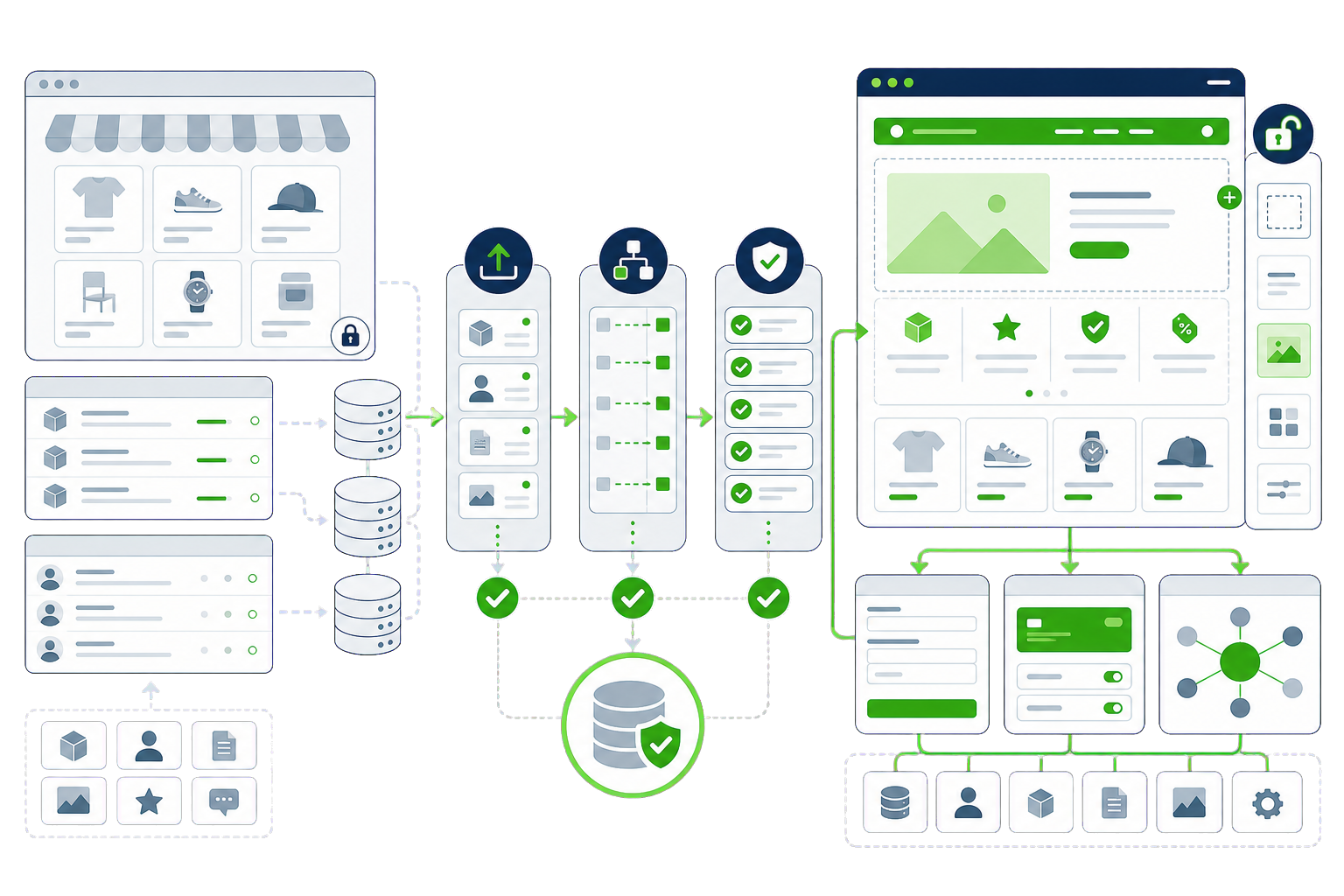
Every migration is a parallel build: your Shopify site keeps running while the new WooCommerce site is built and verified beside it. The switch is a planned window, not a leap.
Questions
If your situation isn't covered here, send us the details and we'll reply with a straight answer.
Yes. Orders export from Shopify and import into WooCommerce so customer service and accounting keep their history. On large stores we do it with migration tooling and verify counts and totals against Shopify’s reports before cutover.
Each app maps to one of three outcomes: a WooCommerce plugin equivalent, functionality WordPress does natively, or — surprisingly often — something you no longer need. We audit the app list early and price the plugin equivalents into the plan, so there are no surprise subscriptions.
Yes, provided it is built and hosted properly — that means hosting sized for uncached checkout traffic, a hardened payment setup tested with real transactions, and monitoring on the checkout path. That is standard scope in our store migrations, not an optional extra.
Yes — that is the point of the parallel build. Shopify keeps trading while WooCommerce is built and tested. At cutover we freeze changes, run a final delta import of the newest orders and customers, switch DNS in a quiet window, and verify with a live test order.